
AI in Creative Industries: Collaborator, Not Competitor
The most useful question about generative AI is not whether it will replace creative work, but how it changes what creative work is for. A practical view from inside the studio.
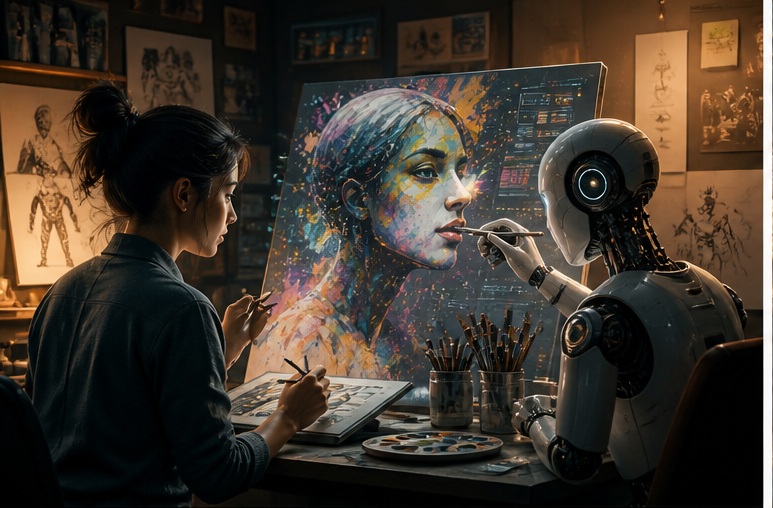
The "AI is coming for creative jobs" headline has been on rotation for about three years. Like most monocausal predictions about new technology, it has aged badly. The reality, as anyone working inside a creative studio in 2026 can confirm, is messier and more interesting.
The question of whether AI will replace creative workers is the wrong question. The right question is: what does creative work become when one of the most labor-intensive parts of it — generating possibilities — costs almost nothing?
What's actually changed in the studio
A working illustrator in 2022 spent a meaningful portion of their day on the tedious foundation of creative work: rough thumbnails, color tests, perspective sketches, photo references. The same illustrator in 2026 spends almost none of their time on that. AI tools have collapsed the cost of generating visual variations to roughly zero.
What hasn't collapsed is the cost of choosing. The hard part of illustration was never producing one drawing — it was knowing which of a thousand possible drawings is the right one for this brief, this audience, this story. AI generates drafts faster than humans can possibly evaluate them. The bottleneck has moved from production to discernment.
The same pattern is showing up across creative disciplines:
- Writers use AI for outlining, alternative phrasings, structural reorganization, and the dread of staring at a blank page. They then spend more of their time on what was always the hard part: deciding what's true, what's worth saying, and how to make a sentence land.
- Composers use AI for sketch tracks, chord-progression exploration, MIDI mockups, and stem separation. The interesting work — taste, structure, emotional arc — is still entirely theirs.
- Designers use AI for moodboarding, variant exploration, and routine asset generation. The strategic work — what the brand is for, what the product should do — has not been automated and shows no sign of being automated.
In all these cases the pattern is similar. AI is excellent at the lower 30% of creative work, the part that involves generating possibilities. It is, so far, useless at the upper 30%, the part that involves choosing among them with judgment.
The collaborator model
The practitioners getting the most out of these tools have stopped treating them as either threats or magic. They treat them, with surprising consistency, as junior collaborators.
A junior collaborator works fast, never gets tired, has read a great deal, and has no taste of their own. You wouldn't let them ship work without supervision. You also wouldn't try to do everything yourself when you have one available. You give them clear briefs, you review their output ruthlessly, and you let them save you from grunt work.
This framing turns out to be remarkably durable. It explains why senior creatives — the people who already had taste and judgment — have benefited enormously from AI tools, while junior creatives have had a harder time. If you don't yet have taste, a tool that produces a thousand options doesn't help you. It floods you.
It also explains why the most successful AI-augmented studios have invested heavily in editorial roles, even as they've shrunk some production-heavy ones. The work is shifting from "make this thing" to "select and refine the right thing from a hundred candidates." That's a different skill, and it's still scarce.
What AI is actually bad at
The honest list of things AI is genuinely bad at — at least as of 2026 — is worth keeping in mind:
- Originality with constraint. AI is good at producing variations on existing styles. It struggles to produce work that is both genuinely novel and tightly constrained by a brief. It tends to drift back toward the statistical average.
- Long-form coherence. Writing tools can produce excellent paragraphs and decent chapters. They cannot reliably produce a 90,000-word novel that holds together structurally.
- Specific cultural nuance. Trained mostly on English-language, Western, internet-era data, AI struggles badly with regional, generational, and subcultural specifics. The work it produces in these registers tends to feel weirdly off, like a fluent non-native speaker.
- Knowing when to stop. AI doesn't know when an idea is finished. A good designer's instinct that a logo is done — that one more iteration would make it worse — is exactly the kind of judgment that tools cannot yet supply.
- Earned tone. A piece of writing whose tone is grounded in the writer's actual experience — a reported essay, a personal memoir, a band's specific sense of humor — cannot be replicated by a system that has no experiences.
These aren't temporary weaknesses. Some of them are likely to be permanent. They mark out the territory where human creative work will continue to matter.
What this means for creative careers
If you're starting a creative career today, the practical implications are reasonably clear:
- Get fluent with the tools. Not because they will save you, but because the cost of not using them is now significant. A photographer who can't use AI-assisted retouching is competing on price with one who can.
- Invest disproportionately in taste and editorial judgment. This is the part of the work that hasn't been commoditized and won't be soon. Read widely. Look critically. Develop opinions you can defend.
- Specialize in the things AI is bad at. Long-form structure. Specific cultural fluency. Original conceptual work. Anything that requires real-world reporting, lived experience, or relationships.
- Don't compete with AI on volume. You won't win. Compete on the things volume can't substitute for: trust, taste, timing, and the small body of work that's clearly yours.
The longer view
Every previous technology that promised to replace creative work — photography, film, recording, desktop publishing, the web — ended up changing what creative work was rather than ending it. Each transition was painful for the people whose specific skills were obsoleted. Each transition also opened up creative possibilities that hadn't existed before.
There's no good reason to think AI will be different. The work will change. Some specific jobs will disappear. Other jobs will be created that we can't yet picture clearly. The constant, across all of these transitions, has been that the human capacity for taste, judgment, narrative, and meaning-making has remained — stubbornly, expensively — in demand.
That capacity is what creative work has always been about. The tools change. The work, mostly, doesn't.