
Biophilic Design: How Nature Is Quietly Reshaping the Modern City
From living walls in Singapore to mossy lobbies in Tokyo, biophilic design is moving from a wellness trend to a serious architectural strategy. Here's why it matters.
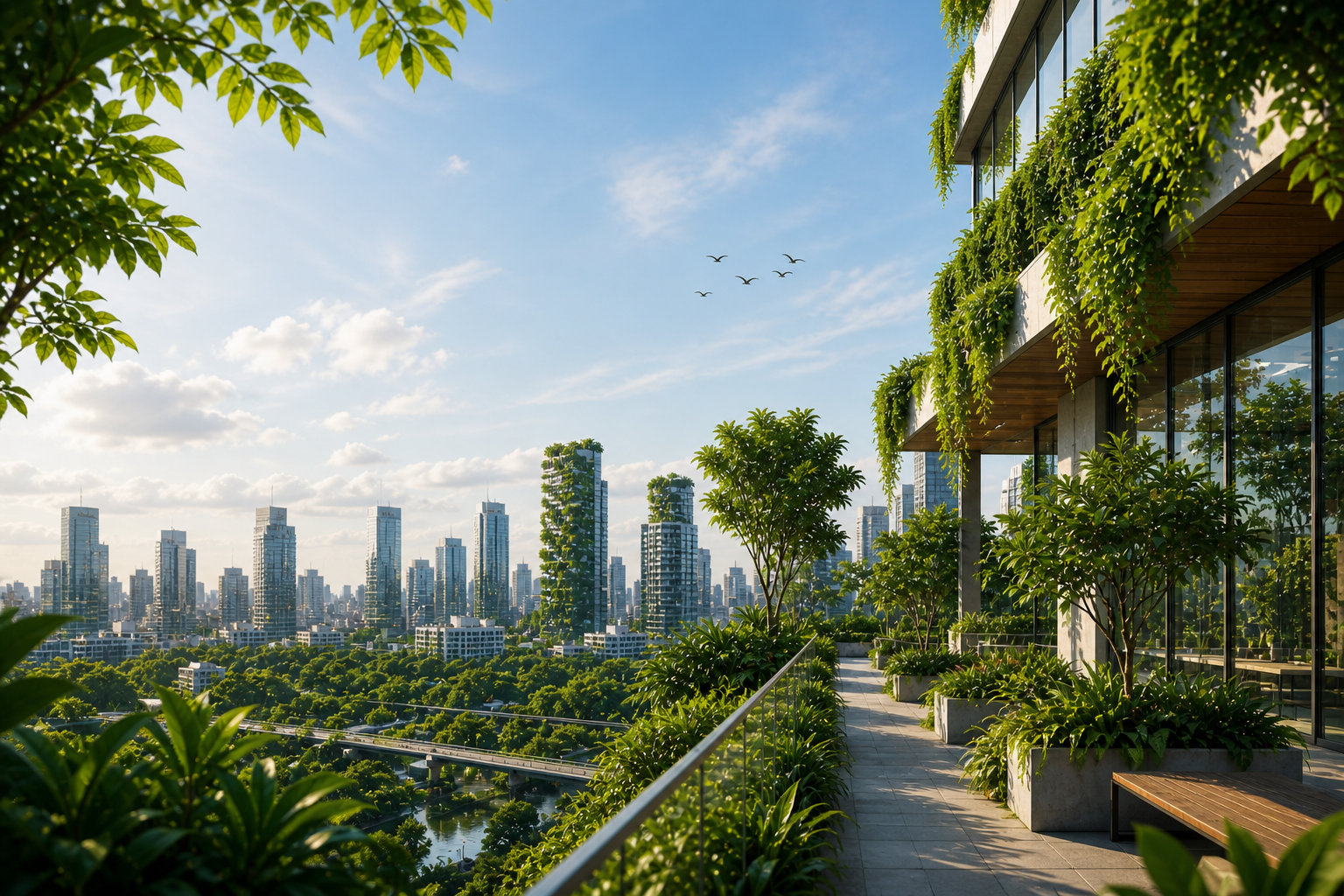
Walk into the Parkroyal Collection on Pickering in Singapore and you'll see something that is technically a hotel but feels closer to a layered hanging garden. Foliage drips from terraces. Sky-bridges bloom with ferns. Even the elevators feel humid in a pleasant, jungle-canopy sort of way. This is biophilic design in its most photogenic form — but the real story behind biophilia is much less Instagrammable, and much more interesting.
What "biophilic" actually means
The term biophilia — literally "love of life" — was coined by biologist E.O. Wilson in 1984. His thesis was simple: humans evolved in close contact with nature, and we still carry the cognitive equipment that responds to natural environments. Sunlight, vegetation, moving water, irregular organic patterns — these aren't aesthetic preferences. They're physiological needs we usually try to satisfy by buying houseplants and going on holiday.
Biophilic design takes that thesis and applies it to buildings. The idea is not "let's add a few succulents to the lobby." It's: what would architecture look like if we treated the human nervous system as a real design constraint?
The three layers of biophilic design
Designers usually break biophilia into three nested categories:
- Direct experience of nature — daylight, plants, water, weather, animals. Think living walls and operable windows.
- Indirect experience of nature — natural materials, natural colors, organic shapes, biomorphic patterns. Think raw timber beams and limewashed plaster.
- Experience of space and place — prospect and refuge, mystery, complexity, transitional spaces. Think mezzanines that feel like treehouses, or corridors that curve enough to invite curiosity.
A well-designed space often hits all three. Bosco Verticale in Milan — the famous "vertical forest" residential towers — gets nature on the balconies, but it also gets the geometry right: residents look out into a layered canopy, not into another window.
Why companies suddenly care
For two decades biophilic design lived mostly in luxury hotels and boutique offices. What changed?
Two things. First, the post-pandemic rethinking of indoor air quality made people sharply aware of how much time they spend in sealed boxes. Second, a growing body of research started putting numbers on what felt intuitive. Studies in workplaces have shown measurable drops in absenteeism, faster patient recovery times in hospital rooms with views of trees, and improved test scores in classrooms with daylight access.
When the cost-benefit math starts to favor a green wall over a marble feature wall, even cost-driven developers pay attention.
Beyond the green wall
The risk in any design movement is that it gets reduced to a single visual cliché. For biophilia, that cliché is the moss wall in the lobby — a beautiful object that requires more maintenance than most facilities teams realize, and contributes very little air quality benefit per square meter. It is, in every sense, decoration.
Real biophilic design is harder and quieter. It looks like:
- Floor plates narrow enough that everyone gets daylight, not just the corner offices.
- Operable windows in climates where mechanical engineers have spent decades arguing against them.
- Atria that double as breeze paths, so you can feel weather even on the eighteenth floor.
- Material palettes that age — patina'd copper, weathered teak, lime plaster that absorbs moisture.
- Sequence and choreography: the slow reveal of a courtyard, the relief of stepping from a tight corridor into a daylit room.
What's next
The most interesting biophilic projects are no longer single buildings but neighborhoods. Singapore's continuing experiment with the "City in a Garden" framework is the obvious example. Copenhagen's network of climate-resilient parks doubles as stormwater management. Seoul's restoration of the Cheonggyecheon stream — taking down a freeway to expose a buried river — turned out to be one of the most successful urban interventions of the early 21st century.
The honest truth is that biophilic design isn't a trend. It's a course-correction. For about 150 years, modern architecture treated nature as something to be excluded — sealed out, conditioned, forgotten about. We're slowly remembering that a building doesn't have to be a sealed box. It can also be a system that breathes.
That, and not the moss walls, is what's worth getting excited about.