
Chemical Chaos in Your Morning Milk: The Hidden Story of ATBC
In a world of convenience, purity is often packaged — and sometimes, so is chemistry.
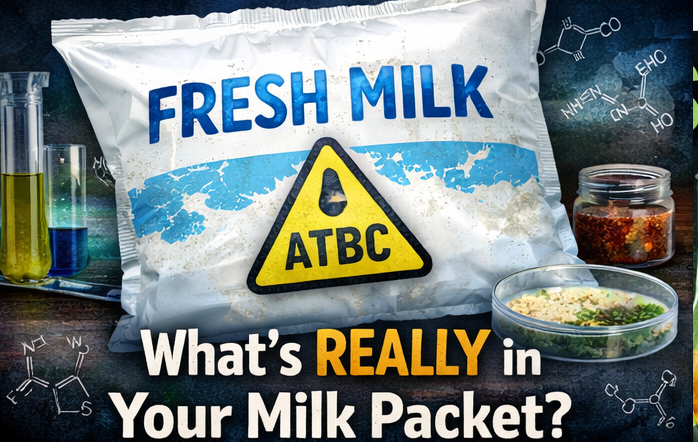
🥛 The Invisible Ingredient in Every Milk Packet
Every morning, millions of Indians cut open a plastic milk pouch and pour what they believe is pure, natural milk into their cups.
But what if your milk isn’t just milk?
Welcome to Chemical Chaos — where even the most basic daily essentials come with unseen industrial chemistry.
🧬 Meet the Chemical: Acetyl Tributyl Citrate (ATBC)
Acetyl Tributyl Citrate (ATBC) is a chemical commonly used in food-grade plastic packaging, including milk packets.
⚠️ Important: ATBC is not added to milk directly — it exists in the plastic packaging.
Why is ATBC used?
ATBC is a plasticizer, which means it:
- Makes plastic flexible
- Prevents cracks and leaks
- Helps packets survive transport
- Improves durability of packaging
Milk packets in India are usually made from LDPE (Low-Density Polyethylene) combined with additives like ATBC.
⚠️ The Real Concern: Chemical Migration
Here’s where things get interesting.
Some chemicals in plastic packaging can migrate into the milk — especially under certain conditions.
🔬 What is Chemical Migration?
It is the process where:
- Chemicals move from plastic → into food/liquid
- Happens over time or with heat
- More likely in fatty liquids like milk
Key findings from studies:
- Up to 65+ chemicals detected in packaging materials
- ATBC found in high concentrations
- Migration increases with temperature and storage time
🧠 Why Should You Care?
Even though these chemicals are used within “safe limits,” the concern is:
👉 Daily exposure over years
Other chemicals found in packaging include:
- Phthalates
- BHT (Butylated Hydroxytoluene)
- Irganox & Irgafos stabilizers
Some research links long-term exposure to:
- Hormonal disruption
- Bioaccumulation
- Potential toxicity risks
🏭 Why Plastic Milk Packets Are Everywhere in India
Plastic milk pouches dominate because they are:
- Extremely cost-effective
- Lightweight and scalable
- Hygienic when sealed
- Easy for mass distribution
Without them, supplying milk daily at scale would be difficult.
🧪 Chemical Chaos or Controlled Science?
Let’s be clear:
- Not all chemicals are harmful
- Not all plastics are dangerous
- Regulations exist (FSSAI standards)
However, safety depends on:
- Manufacturing quality
- Storage conditions
- Supply chain discipline
Even small lapses can increase exposure.
🔍 What You Can Do (Practical Tips)
Simple steps to reduce risk:
- ❄️ Avoid heat exposure of milk packets
- 🧼 Wash packet before cutting
- ⏱️ Transfer milk to steel/glass immediately
- 🔥 Do not heat milk in plastic contact
- 🏷️ Choose trusted brands
🧩 Final Thought: The Illusion of Simplicity
Milk appears simple.
But behind it lies a system of:
- Industrial materials
- Chemical engineering
- Large-scale logistics
ATBC is just one example — a reminder that modern convenience often comes with hidden complexity.