
Festivals of Light: Celebrations That Illuminate the World
From Diwali in Jaipur to Loi Krathong on the Chao Phraya, light festivals are humanity's oldest and most universal form of communal storytelling. Here's a tour.
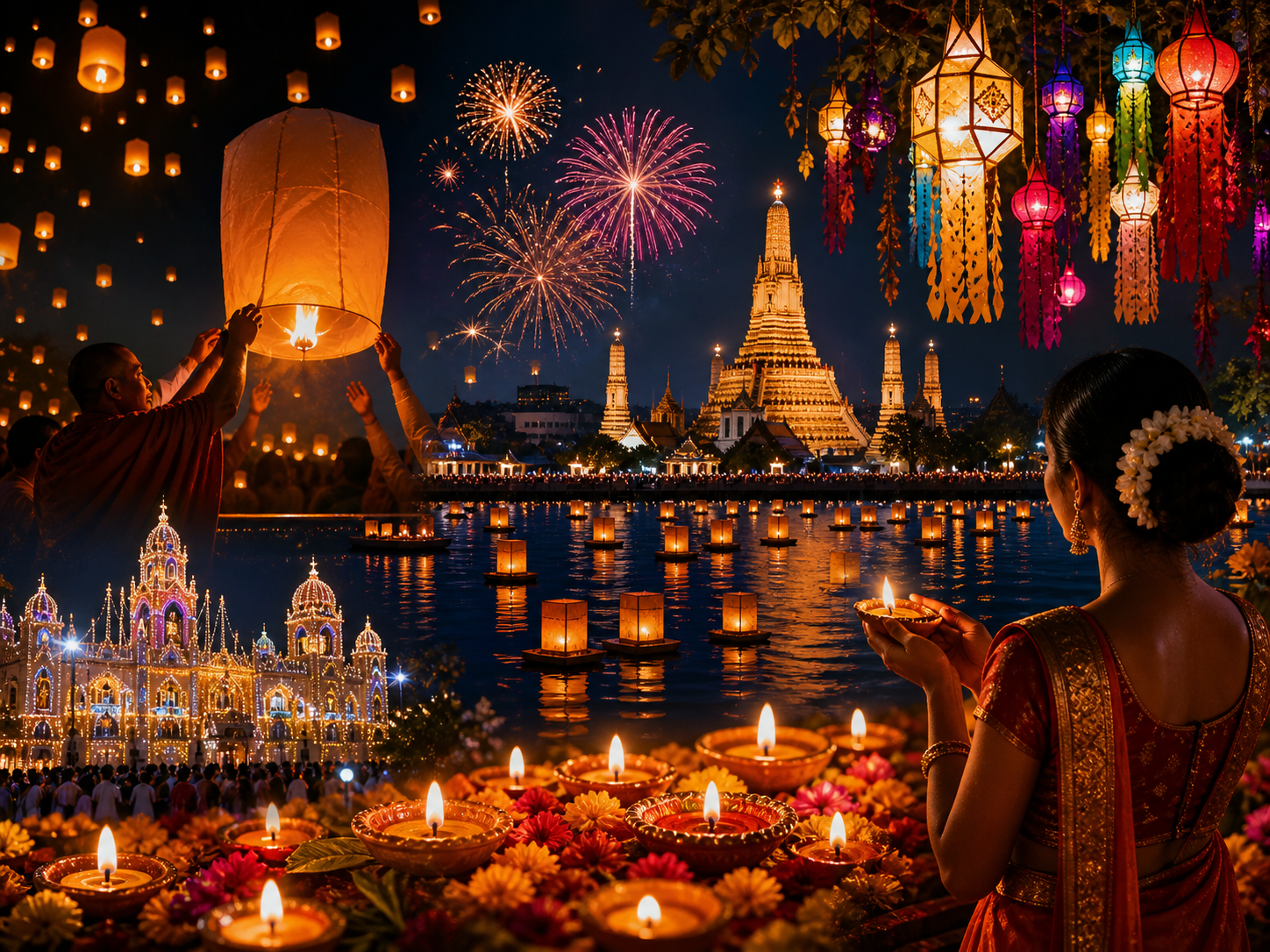
Long before electricity, before cities, before agriculture, our ancestors were watching the sky. They noticed when the days grew shorter and the nights grew colder. They noticed when the sun, after months of decline, began to climb again. And they marked those moments — every culture, on every continent — with fire.
This is the deepest layer of every light festival. Beneath the religious narratives, the seasonal stories, the family rituals, there is a much older instinct: when the dark presses in, light a flame, and gather close to it.
Diwali, India
The most widely celebrated light festival on Earth, Diwali marks the triumph of light over darkness, knowledge over ignorance, good over evil. The exact origin story varies by region — Lord Rama's return to Ayodhya in the north, Lakshmi's blessings in the west, Krishna's defeat of Narakasura in the south — but the practice is consistent: oil lamps (diyas) lit in every doorway, every windowsill, every rooftop.
In Jaipur or Varanasi, the effect is something close to overwhelming. Whole neighborhoods glow. The air is thick with marigolds, fireworks, and sweets. Children draw rangoli patterns on the floor in colored powder. The festival lasts five days, each with its own ritual focus, but the central image — small flames, multiplied across an entire civilization — never quite fades from memory once you've seen it.
Hanukkah, Jewish Diaspora
Hanukkah is the smaller, quieter cousin in the family of light festivals — and it is meant to be that way. The story it commemorates, the rededication of the Second Temple in Jerusalem in the 2nd century BCE, is built around the survival of a single small flame: enough oil for one day, miraculously lasting eight.
The ritual is correspondingly intimate. A menorah (or more precisely, a hanukkiah) is lit each night, one new candle added each evening for eight nights. The candles are placed in a window where they can be seen from the street — a quiet act of public witness. Many Jewish families in the diaspora have layered traditions on top: latkes, sufganiyot, dreidel games — but the heart of Hanukkah is the candle in the window. Light, persisting against the odds, witnessed by anyone who happens to walk by.
Loi Krathong, Thailand
On the night of the twelfth full moon of the lunar calendar, Thais float small lotus-shaped baskets — krathongs — onto rivers and lakes. Each one carries a candle, a stick of incense, and often a hair clipping or fingernail trimming, symbolically letting go of misfortunes from the past year.
In Bangkok, the Chao Phraya river fills with thousands of drifting candles. In Sukhothai, the festival is paired with light shows around the ancient temple ruins. The image is impossible to forget: a slow, uncountable river of small flames moving downstream, carrying the year away.
Yi Peng, Northern Thailand
Often confused with Loi Krathong because they overlap, Yi Peng is northern Thailand's parallel tradition: floating lanterns into the night sky rather than candles onto the water. In Chiang Mai, the mass release looks like the stars themselves are migrating upward, thousands of paper lanterns rising in waves over the city.
The ritual is meditative. Each lantern carries a wish, a prayer, sometimes a name. The act of release — physically letting go of the lantern, watching it climb beyond reach — is the entire point.
Las Fallas, Spain
Valencia's Fallas festival in March is light at its most theatrical and most destructive. For weeks, neighborhoods build enormous papier-mâché sculptures, often satirical, often political, sometimes towering five or six stories tall. On the final night, La Cremà, every sculpture in the city is set on fire.
It's an astonishing thing to witness. The streets fill with flame. Months of work, sometimes years, are deliberately consumed in a single night. The argument behind it is, in its way, the same argument behind every other festival on this list: light needs darkness, creation needs destruction, the year is a wheel that has to turn.
Lantern Festival, China
Marking the end of the Chinese New Year celebrations, the Lantern Festival has been observed for over two thousand years. Red lanterns are hung in homes, temples, public squares. Lantern riddles — short poems written on the side of each lantern — are exchanged. Sweet rice dumplings (tangyuan) are eaten, their round shape symbolizing family togetherness.
In Pingxi, on the outskirts of Taipei, the festival has merged with sky-lantern release in a way that visually echoes Yi Peng. In Nanjing's Confucius Temple area, the lanterns date back centuries and the streets are essentially impassable on festival night, in the best possible way.
What they have in common
Strip away the religious specifics and a pattern emerges. Every one of these festivals does three things at once:
- It marks time. Festivals of light cluster around solstices, lunar phases, and seasonal turning points. They are humanity's way of noticing that the year is moving.
- It gathers people. The light is almost always shared — placed in a public window, floated downstream, released into a public sky. It is light with others, not light alone.
- It rehearses hope. Every one of these stories, in some form, is about light returning, persisting, or being passed on. They are practical exercises in optimism, repeated annually in case we forget.
In a year that often feels heavy, this is what the world's light festivals quietly insist: the dark is real, but so is the flame, and people have been gathering around it together for a very, very long time.