
Reimagining the Skyline: How Vertical Forests Are Reshaping Cities
Bosco Verticale was a manifesto in concrete and trees. Six years on, vertical forests have spread from Milan to Nanjing, Eindhoven, and Utrecht — and the lessons are getting interesting.
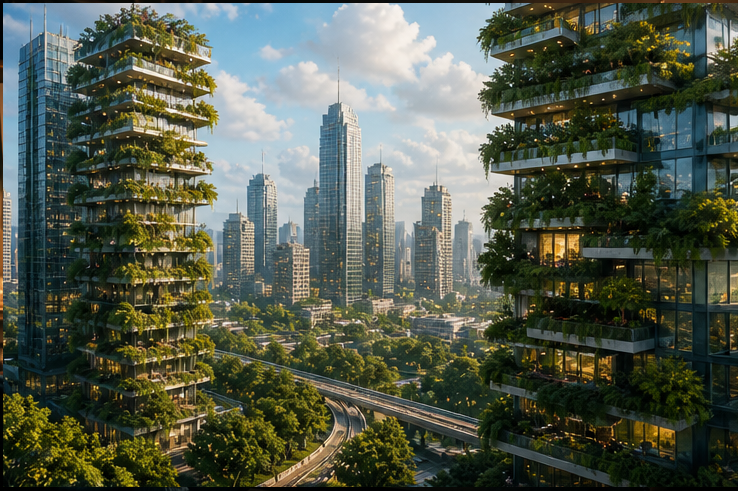
When Stefano Boeri unveiled Bosco Verticale in Milan in 2014, the reaction was a mixture of awe and skepticism. Two residential towers, 110 and 76 meters tall, planted with around 800 trees and 20,000 shrubs and perennials. It looked beautiful in renderings and oddly improbable in reality — twin slabs of concrete, balconies sagging slightly under the weight of full-grown trees, a hawk occasionally circling.
A decade later, the question isn't whether the buildings worked. They did. The question is what we've learned from the global wave of imitators that followed.
What Boeri actually proposed
The pitch was simple. Cities suffer from heat islands, air pollution, and biodiversity collapse. Trees solve all three. We don't have horizontal space for them in dense urban cores. So put them on the buildings.
The numbers Boeri's office quoted at launch — equivalent to roughly two hectares of forest packed into a single city block — were necessarily approximate. But the underlying logic was hard to dismiss. A mature tree, even on a balcony, transpires water (cooling the air), captures particulates, sequesters carbon, and supports an actual ecosystem of insects and birds.
What Bosco Verticale really was, more than a building, was an argument: that nature in dense cities doesn't have to live only in parks.
What works (the parts you can copy)
After ten years of monitoring, certain things are now clear:
- Microclimate effects are real. Surface temperatures on planted facades run several degrees cooler than equivalent unplanted facades in summer. Apartments behind the planting need less air-conditioning.
- Air quality benefits are measurable but local. The trees absorb particulate matter and CO₂ in measurable quantities, but the effect doesn't scale to the city block — it stays in the immediate vicinity. As personal-scale air quality, it's meaningful. As an air-quality strategy for a city, it isn't.
- Biodiversity has surprised everyone. Bird and insect species counts in and around Bosco Verticale are an order of magnitude higher than equivalent surrounding buildings. The buildings have become functional habitat patches in a fragmented urban ecosystem.
- Resident wellbeing data is consistent. Surveys and biometric studies of residents in vertical-forest buildings consistently show lower self-reported stress and better recovery from cognitive fatigue than residents in matched conventional buildings.
What doesn't work (the parts the renderings hide)
Some things have been harder than the press images suggest:
- Maintenance is a real industry. Pruning, irrigation management, plant replacement, structural inspection of the planters — all of this requires a trained team. Bosco Verticale uses arborist-climbers ("flying gardeners") to do the maintenance from outside. That's a permanent operating cost most developers underestimate.
- The structural overhead is enormous. Mature trees are heavy, especially when their growing medium is wet. The planter cantilevers and tree root anchoring required at Bosco Verticale added significant cost and structural mass per floor. This is why the design is harder to copy in cost-sensitive markets than people assume.
- Plant selection is everything. Several early imitators planted species that simply could not survive the wind exposure, soil depth, or urban climate of their site. Within three years, several "vertical forest" projects looked more like vertical kindling. The successful follow-on projects (Nanjing, Utrecht, Eindhoven) have all worked with arborists from day one of design.
- It's not a carbon-neutral magic trick. The carbon sequestered by 800 trees, even mature ones, is small compared to the embodied carbon of the concrete needed to hold them up. Vertical forests are good urban environments. They are not, on their own, climate solutions.
The follow-on projects worth watching
Boeri's office has now built or is building vertical forests in Nanjing, Utrecht, Eindhoven, Tirana, and a half-dozen other cities. Beyond Boeri, the typology has spread: BIG, MVRDV, WOHA in Singapore, and a wave of Chinese practices have all built variations.
The most interesting projects right now are the ones that aren't trying to be Bosco Verticale 2.0. WOHA's Oasia Hotel in Singapore is wrapped in a creeper-covered mesh facade — far cheaper to build and maintain than discrete tree planters, with similar microclimate benefits. Stefano Boeri's "Liuzhou Forest City" masterplan in China extends the typology to a whole district scale, where the planted facades are a contributing element rather than the main act.
The honest reading is that vertical forests are not the universal model for green high-rise architecture. They're one tool, and a beautiful one, in a much larger toolkit that includes green roofs, planted facades, urban farms, restored streams, and the unglamorous work of street tree planting.
What's actually next
The real frontier of green architecture is less photogenic than vertical forests. It's better insulation, lower-carbon concrete, mass timber structural systems, district-scale heat networks, and serious building reuse instead of demolition. None of these will appear on a magazine cover the way a tree-covered skyscraper does.
But Bosco Verticale's lasting contribution may be cultural rather than technical. It showed, at the scale of a city block, that buildings don't have to fight nature. That they can be habitat. That the line between "building" and "ecosystem" is more porous than the construction industry has been pretending for a hundred years.
That argument, more than the trees themselves, is the one worth carrying forward.