
The Quiet Revolution of Sustainable Fashion
Sustainable fashion has moved past the buzzword stage. The brands worth watching aren't the ones using the loudest green language — they're the ones rebuilding the supply chain, slowly and unglamorously.
For about a decade, "sustainable fashion" mostly meant a hangtag. A bamboo-fiber t-shirt sold in a recycled cardboard box. A capsule collection labelled "conscious." A press release announcing a new partnership with a recycler.
Most of that was, to put it gently, theater. The hard truth is that fashion is one of the most resource-intensive industries on earth, and the structural problems — synthetic-fiber microplastic pollution, textile waste mountains in Ghana and Chile, garment-worker wages that haven't risen in real terms in a generation — have proven stubbornly resistant to clever marketing.
What's interesting in 2026 is that the most credible work is finally happening below the marketing layer. The brands and projects worth watching aren't the ones with the greenest hangtags. They're the ones quietly rebuilding parts of the supply chain that were never meant to be questioned.
Material innovation, finally beyond hype
The materials story has been overpromised for years. "Mushroom leather" has been on the cusp of disrupting the leather industry since at least 2017. Most of it didn't scale, mostly because consumers liked the idea more than the product.
The materials that are scaling now tend to be quieter:
- Mechanically recycled cotton — not as glamorous as chemical recycling, but it works at scale today and avoids the energy intensity of virgin cotton.
- Next-gen cellulosic fibers like Tencel Lyocell and lyocell blends, made in closed-loop solvent systems where over 99% of chemicals are reused.
- Bio-based polyester precursors from agricultural waste streams, displacing fossil PET in specific use cases.
- Wool, linen, and hemp — old fibers that turned out to be the right answer for many garments all along.
None of this is going to "save fashion." But collectively, it's the first time in a decade that the materials story has felt like more than a press release.
The supply chain you don't see
Fashion's real environmental footprint sits in places consumers never look: the dye houses of Tirupur, the wet processing facilities of Guangdong, the cut-and-sew workshops of Dhaka. The honest, boring work of sustainability is mostly happening here.
A few things have shifted:
- Wastewater reuse in dyeing has gone from a curiosity to a near-requirement for major brand suppliers.
- Renewable energy procurement is rolling through tier-2 supplier networks, especially in Vietnam and Bangladesh.
- Living wage benchmarking — actually computing what a worker needs to live, not just whether the legal minimum is paid — is starting to be referenced in major brand contracts. Patagonia and a small handful of others have led; many more are quietly following.
This is profoundly unsexy work. There is no Instagram post that captures a wastewater treatment retrofit. But it's the part that matters.
What "slow fashion" actually buys you
The slow fashion movement is older than the sustainability conversation, and on some level it's the simplest answer: buy fewer things, of better quality, and wear them longer. The math is hard to argue with. A jacket that lasts ten years, even if it has a higher embodied carbon footprint than a fast-fashion equivalent, almost always wins on a per-wear basis.
What's changed recently is that resale infrastructure has finally matured. Vestiaire Collective, The RealReal, Vinted, Depop, Grailed — these aren't fringe channels anymore. For many garments, they're a meaningful second life. A jacket that gets worn for ten years and then sold for another five is doing the kind of work that no amount of recycled-polyester marketing can replicate.
How to actually shop differently
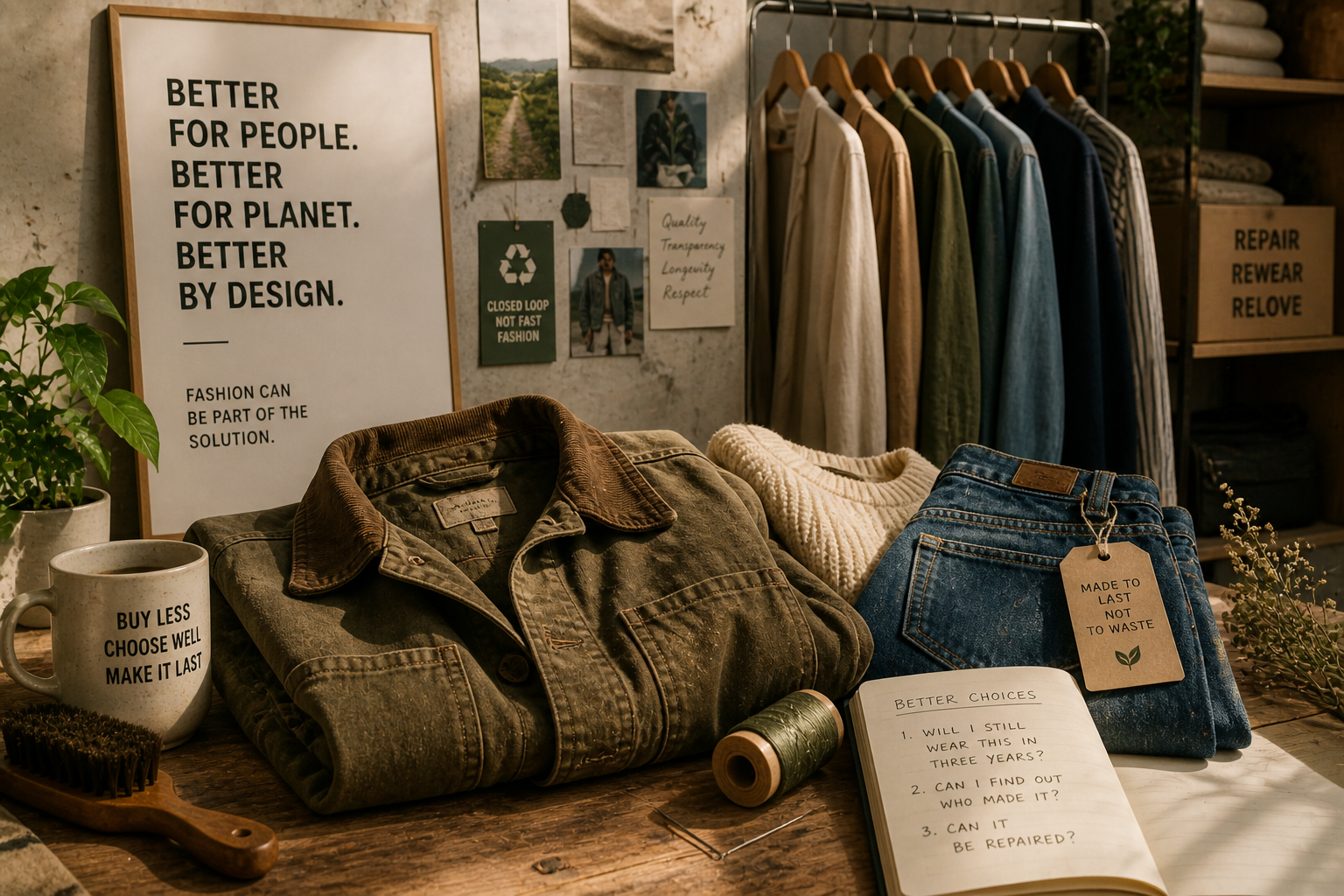
If you want a practical filter, ignore most of what's printed on the hangtag and ask three questions:
- Will I still wear this in three years? Trend-driven garments rarely survive that test. Classics usually do.
- Can I find out who made it? Brands serious about supply chain transparency will tell you. Brands that are not will give you a vague "made with care" answer.
- Can it be repaired? A pair of boots with a Goodyear welt, a coat with replaceable buttons and a real lining, jeans that can be re-hemmed — these are signals that a garment was built for a long life.
Sustainable fashion isn't a category of products. It's a way of using what you buy. The shift that matters most isn't happening in the showroom; it's happening in the closet, when we stop treating clothing as disposable and start treating it as something worth keeping.
The revolution, this time, looks a lot less like a manifesto and a lot more like a worn-in jacket that you've already had for five years and plan to keep wearing.