
The Vinyl Renaissance: Why Records Sound So Right Again
Vinyl outsold CDs in 2022 for the first time since the 1980s, and it hasn't stopped growing. The story is less about audiophiles than you'd think — and more about how we relate to music itself.
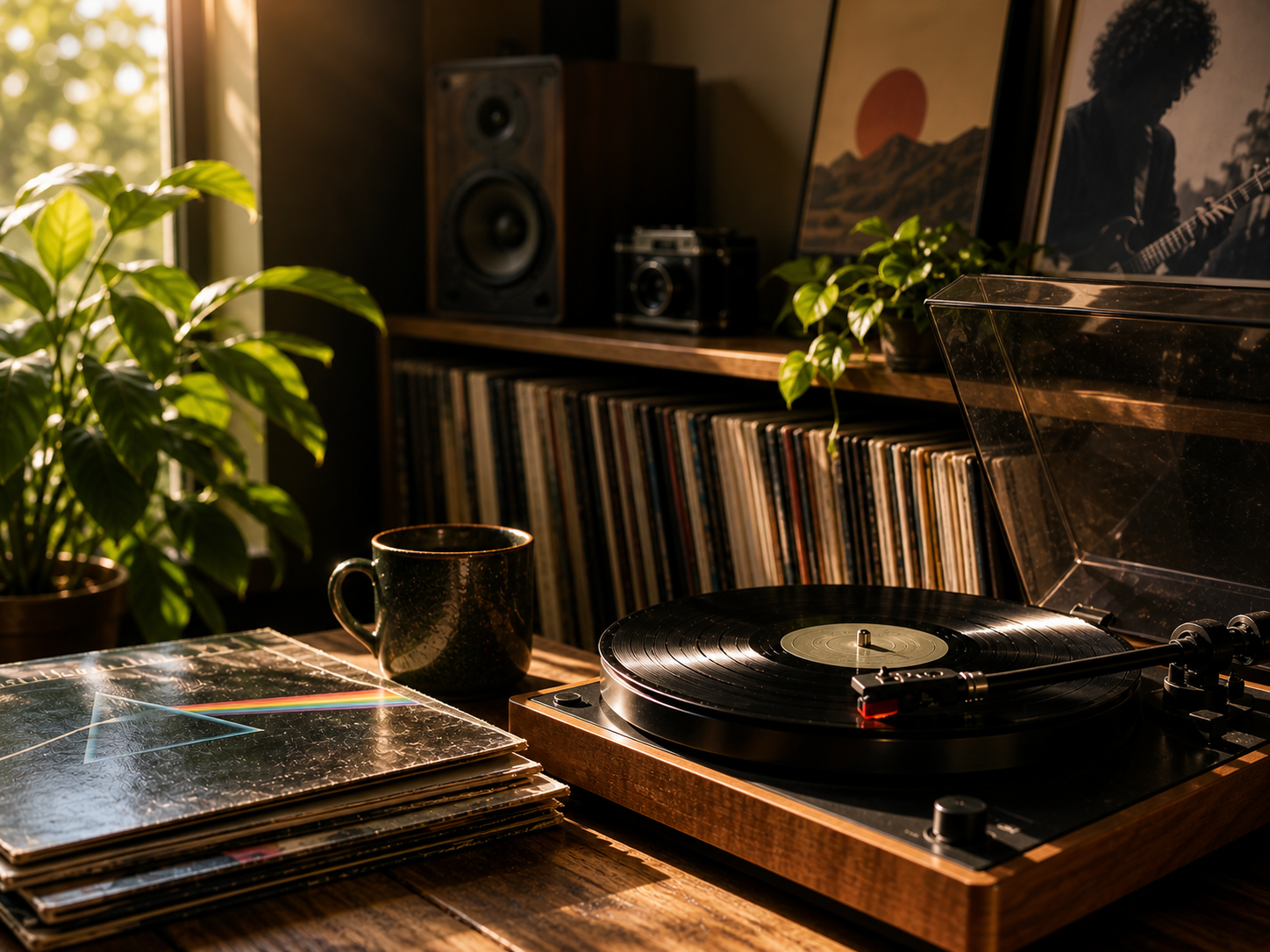
For about twenty years, vinyl was supposed to be dead. Then, very quietly, it stopped being dead.
In 2022, vinyl record sales overtook CD sales in the United States for the first time since 1987. By 2024 the global market had crossed two billion dollars in revenue. Pressing plants — most of which had been mothballed since the late 1990s — are running waitlists of nine months or longer. New plants are opening for the first time in a generation.
This is not what an obsolete format does. So what's actually going on?
It's not really about sound quality
The audiophile case for vinyl is real but narrow. A well-cut record played on a well-set-up turntable into a competent system can sound extraordinary — warm, dynamic, with a particular sense of spatial depth that streaming compression genuinely flattens. Many vinyl pressings are also mastered separately from their digital counterparts, often more dynamically.
But the average vinyl listener is not playing a $4,000 cartridge into a tube preamp. They're playing a $300 turntable into a Bluetooth speaker, often with an entry-level cartridge that is, by any measurable standard, audibly worse than a streamed lossless file.
If vinyl's resurgence were really about sound quality, the tape and high-resolution-digital scenes would have grown faster. They haven't. Whatever's driving vinyl is something else.
It's about ownership
Streaming gave us functionally infinite music for the price of a sandwich a month. That sounded like utopia. In practice it has produced a strange and quiet form of grief: the realization that we don't actually own any of it.
A user's "library" on a major streaming service is a list of links, not a collection. A song can disappear tomorrow because of a licensing dispute. An entire artist's catalog can vanish overnight. A playlist you spent months curating can be partially destroyed without notice. None of this happens with a record on your shelf.
This sounds melodramatic until you realize how many people experienced it personally. The licensing wobbles of the early 2020s — major artists pulled from major platforms, classic albums quietly replaced with re-recorded versions, regional catalog gaps — taught a generation of listeners that streaming is rented, not owned. Records are owned.
It's about attention
A streamed song asks nothing of you. It begins because you tapped a button. It ends because the algorithm chose what comes next. The medium is shaped to be ignored — to play in the background while you do other things.
A record asks the opposite. You take it out of its sleeve. You inspect it for dust. You set it down on the platter and lower the needle by hand. You sit through one side, six or seven songs, and then physically get up and flip it. You do this not because it's sonically necessary but because the medium is built to make you pay attention.
This is, in 2026, profoundly countercultural. Almost everything else in our media environment is engineered to maximize the number of things competing for our attention at once. Vinyl does the opposite. It is, structurally, an anti-distraction technology.
A lot of people have realized that the experience of listening to one album, all the way through, with no other tabs open is something they had quietly stopped doing for a decade. Records are bringing it back, not because the technology is special, but because the friction is.
It's about objects
The collapse of physical media coincided with a wider cultural shift toward digital everything: photos, books, movies, music, mail. We were promised we wouldn't miss the boxes. For some of those categories — printed bills, video rentals — we don't. For others, the loss has been quieter and more lasting.
A record is an object you own. The cover art is real and large enough to look at properly. The liner notes are physical, not buried in a metadata sidebar. The sleeve develops a faint patina over the years. You can give a record to someone. You can inherit one. You can put it on a shelf and have it visibly, meaningfully, be there.
This isn't nostalgia. It's a re-discovery that some categories of cultural object work better when they're physical. Books survived the e-reader era for the same reason. Vinyl is part of the same pattern.
What this changes
A few practical things have shifted as a result of the renaissance:
- Album art matters again. For the first time in two decades, art directors are designing covers as if people will look at them at 12 inches square. Some of the best album packaging in 30 years is being produced right now.
- Albums as albums are recovering. When listeners commit to listening side-by-side, the album as an artistic unit makes sense again. Several of the most acclaimed records of the last few years have explicit "side A / side B" structures that streaming-only releases would not have produced.
- Artists make real money from physical sales. Streaming royalties for all but the largest artists are negligible. A vinyl pressing of a few thousand units, even at indie scale, can fund the next record. Bandcamp Friday is no longer the only meaningful direct-to-fan revenue stream.
- Listening rooms are returning. Bars and small venues centered around playing records on serious sound systems — long a Tokyo specialty — are opening in cities from Brooklyn to Berlin to Bangkok.
How to start, if you want to
If the vinyl renaissance has caught your attention and you're tempted to start, a small set of unromantic suggestions:
- Buy a turntable in the $300–$600 range. A Pro-Ject Debut, an Audio-Technica AT-LP120X, a Rega Planar 1. Below that, you'll mostly damage the records. Above that, the marginal returns shrink fast for a beginner.
- Buy a phono preamp. Some turntables include one. Most amplifiers don't. You need one somewhere in the chain.
- Start with records you actually love. Not records you think you should own. The whole point of the medium is the experience of returning to specific records over and over.
- Treat them well. A record sleeve, a stylus brush, an anti-static cloth. The maintenance ritual is part of the experience and it dramatically extends the life of both the records and the cartridge.
In an era when almost all of our music is rented from a server in someone else's data center, owning a record — putting it on, listening to it, putting it back on the shelf — has become a small but meaningful act of attention. It turns out a lot of people were quietly missing that. The renaissance, on closer inspection, isn't really a comeback. It's a correction.