
Walls That Speak: Street Art as Modern Social Commentary
From Bogotá's protest murals to Tehran's underground stencils, contemporary street art has become one of the most direct forms of political speech in the world.
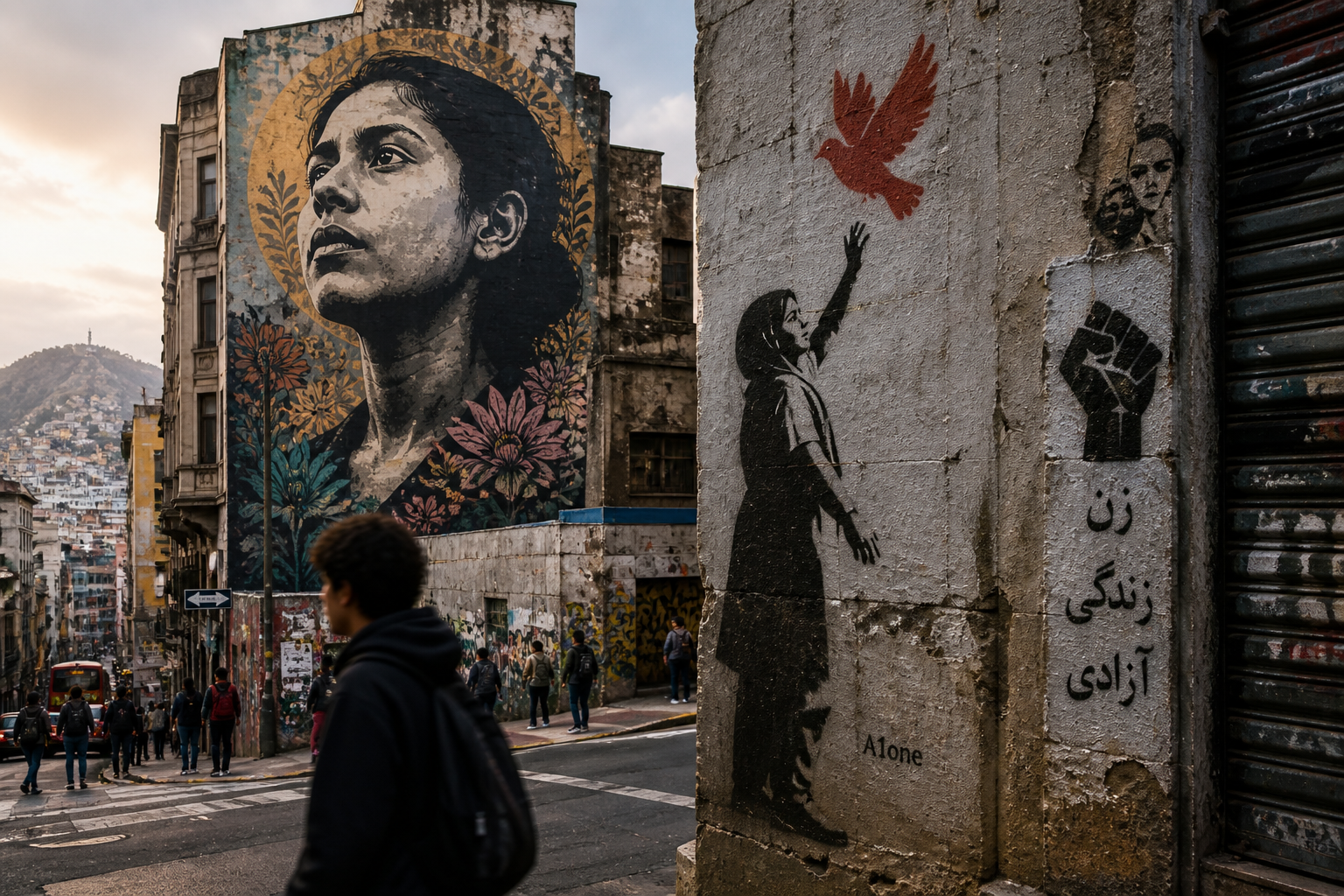
There's an old idea that street art "democratizes" the gallery — that it takes the high-priest experience of contemporary art and puts it on a street corner where anyone can see it. That framing was always a little patronizing, and it has aged badly. The artists working today on walls from Bogotá to Tehran aren't lowering the velvet rope. They're doing something the gallery world rarely tries to do at all: speaking, in public, about the present.
A medium with built-in audience
Painting on a wall has one enormous advantage over painting on canvas: it does not require the viewer to walk through a door. A 12-meter portrait of a disappeared activist, painted on the side of a downtown building, is encountered by every commuter, every shopkeeper, every kid waiting for a bus. There is no admission fee, no curatorial framing, no need to know what year the artist was born.
This makes street art an unusually effective medium for political speech, and it explains why the most interesting work of the last decade has come from cities where speech itself is contested.
Bogotá: walls as a peace process
Colombia's capital has, by accident or design, become one of the great mural cities of the world. The catalyst was a 2011 incident in which a graffiti artist, sixteen-year-old Diego Felipe Becerra, was shot and killed by police. The public outcry that followed pushed the city government to recognize street art as cultural expression rather than vandalism — and the resulting permissiveness produced an explosion of large-scale work. Today, neighborhoods like La Candelaria function as open-air galleries with murals about colonial history, the long civil war, indigenous identity, displacement, and ecological loss. Local artists like Guache and Carlos Trilleras are read here the way novelists are read elsewhere.
Tehran: stencils as resistance
In contrast to Bogotá's officially tolerated scene, Iran's street art operates entirely underground. Anonymous collectives like A1one and Black Hand have built reputations for politically charged stencil work that appears overnight on Tehran's walls — and is usually painted over within days. The constraint shapes the form: small, fast, repeatable images, designed to be photographed and circulated online before they vanish. The work is a reminder that the most subversive art doesn't always shout. Sometimes it whispers, in spray paint, on a wall that won't be there tomorrow.
Lisbon, Belfast, Cape Town
Other cities have found their own dialects. Lisbon's Galeria de Arte Urbana commissions enormous works that turn whole apartment blocks into portraits — Vhils' chiseled faces in particular feel almost archaeological. Belfast's evolving murals chart the city's relationship to the Troubles, layering peace process imagery over older sectarian iconography. Cape Town's mural scene, especially in Woodstock and Salt River, has become a flashpoint in conversations about gentrification — the very murals that revitalized the neighborhood are now seen by some residents as the opening move in their own displacement.
The complication of legality
Street art's political power lives in tension with its legal status. The moment a piece is commissioned, permitted, sponsored, it stops being graffiti in any meaningful sense and becomes public art. That isn't necessarily a bad thing — many of the most ambitious large-scale works exist only because of legal sanction — but it does change what the work can say. A mural funded by a city council is unlikely to criticize that council with much force.
This is why the most interesting street art ecosystems usually contain both: the festival-commissioned 30-meter pieces and the unauthorized stencil that goes up at 3 AM. They need each other. One pays the rent and trains the next generation; the other keeps the form honest.
What it tells us about a city
You can read a city through its walls. The presence of large, permitted murals tells you how a city wants to be seen. The presence of small, illegal work tells you what the city is actually arguing about with itself. A street art scene without both is either too repressed or too domesticated.
Walk slowly. Look up. The walls are talking, and they're often saying things the front pages aren't.